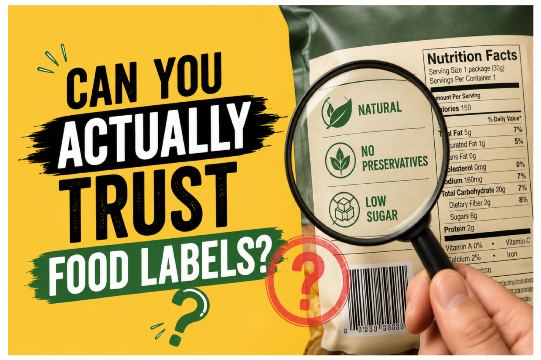
You pick up a packet of biscuits. The front says "Made with Real Fruit," "No Added Sugar," and "Natural Goodness." It feels like a safe choice. Then you flip it over and the ingredient list tells a slightly different story.
So, can you trust food labels? The honest answer: mostly yes on the facts, much less on the marketing. The trick is knowing which part of the packet is which.
Two Labels in One
Every packaged food carries two very different kinds of information.
The back of the pack is the regulated part: the ingredient list, nutrition table, allergen warnings, net weight, manufacturing and expiry dates. Rules govern what must appear here, and regulators can penalise companies that get it wrong. In India, this is overseen by the FSSAI; in the US, the FDA; in the EU, the European Commission and national authorities.
The front of the pack is the advertising part. Companies have wide freedom here, as long as claims aren't outright false or misleading. This is where words like "wholesome," "farm fresh," or "power-packed" live, and where most confusion begins.
Where Labels Are Reliable
Ingredient lists are ordered by weight. The first ingredient is the most abundant, and the last is the least. If sugar, refined flour, or palm oil sits at the top, that is what you are mostly eating, whatever the front says.
Allergen declarations are taken seriously. Mislabelled allergens are among the most common reasons for product recalls, because the health risk is immediate. If you have a food allergy, the allergen statement is one of the most dependable pieces of information on the pack.
Veg and non-veg marking is mandatory in India. The green dot and brown dot system is a simple, legally required signal.
Protected terms like "organic" are certified. Where a label claim is tied to a certification scheme with audits, it carries real weight. Look for the certifying body's logo rather than just the word.
Where Labels Get Slippery
1. The serving size trick
Nutrition tables are often shown "per serving," and the serving can be unrealistically small. A packet of chips listing 150 calories per serving looks modest until you notice the packet contains three servings. Always check the servings per pack, or compare using the per 100 g column, which lets you compare products fairly.
2. "Zero" doesn't always mean zero
In many countries, rounding rules allow a product to claim "0 g trans fat" or "zero sugar" when the amount per serving is below a small threshold. Eat several servings and those "zeros" add up. The ingredient list is the check: look for "partially hydrogenated oils" in the case of trans fats.
3. "Natural" means very little
In most markets, "natural" has no strict legal definition. A product can be called natural and still be heavily processed. It is a feeling, not a standard.
4. Health halos
Claims like "high in protein," "multigrain," "baked not fried," or "made with real fruit" make a product sound healthy without telling you the full picture.
- Multigrain only means more than one grain. It does not mean whole grain. Look for "whole wheat" or "whole grain" as the first ingredient.
- Made with real fruit can mean a tiny percentage of fruit paste in a sugary product.
- Baked, not fried says nothing about sugar, salt, or refined flour.
5. Sugar by many names
Sugar hides under dozens of names: glucose syrup, invert sugar, maltodextrin, dextrose, fruit juice concentrate, jaggery powder. Because manufacturers can split sugar into several types, no single one appears at the top of the list, even when together they dominate the product.
6. Small print on the numbers
Nutrition values on labels are allowed a tolerance. Regulators generally accept some variation between the stated figures and what independent lab tests find. The numbers are good estimates, not exact measurements.
What Independent Testing Tells Us
Consumer organisations and researchers in several countries have tested packaged foods and found that most labels are broadly accurate, but with notable exceptions. Protein content in supplements, "fruit" content in drinks, and honey purity have all been subjects of public controversy over the years. The pattern is consistent: the further a claim drifts from a regulated number and toward marketing language, the less you should rely on it.
A Quick Label-Reading Routine
You don't need to become a nutritionist. Try this 30-second routine:
- Ignore the front. Turn the packet over first.
- Read the first three ingredients. They make up the bulk of the product.
- Check the serving size against how much you will realistically eat.
- Compare per 100 g when choosing between two products.
- Scan for added sugar, salt, and saturated fat, and notice where they fall in the list.
- Prefer shorter ingredient lists with items you recognise, as a rough rule of thumb.
The Bottom Line
Food labels are not lies, but they are not neutral either. The regulated information on the back is largely dependable. The claims on the front are written by marketers whose job is to sell. Treat the front as an advertisement and the back as the fact sheet, and you will make better choices with very little effort.
The next time a packet promises "goodness," turn it over and ask a simple question: what is actually in here? The label will usually tell you, if you know where to look.