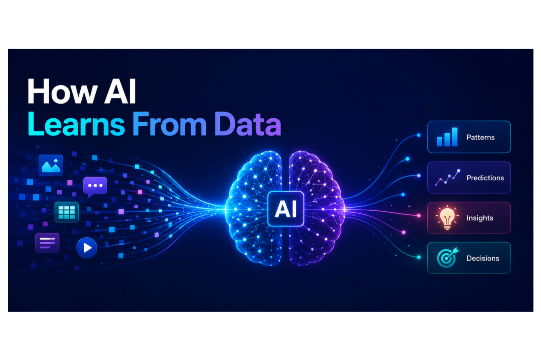
How AI Learns From Data: Understanding the Science Behind Artificial Intelligence
Artificial Intelligence (AI) is transforming the way we learn, work, communicate and solve problems. From voice assistants and personalised recommendations to self-driving cars and intelligent chatbots, AI is becoming part of our everyday lives.
But have you ever wondered how AI actually learns? Does a computer think like a human? How does it recognise pictures, understand language or predict what someone might want to watch next?
The answer lies in data.
Just as humans learn from experiences, observations and practice, AI systems learn by analysing large amounts of data, identifying patterns and using those patterns to make predictions or decisions.
Let's understand how this fascinating process works.
1. What is Data and Why Does AI Need It?
Data is information that can be collected, stored and analysed. It can take many forms, including:
- Text from books, websites and articles.
- Images and photographs.
- Videos and audio recordings.
- Numbers, measurements and statistics.
- Information about everyday activities and behaviours.
AI uses data as its learning material. Without data, most modern AI systems would have nothing to analyse or learn from.
For example, imagine teaching a computer to recognise cats.
You show it thousands of pictures of cats, dogs, birds and other animals. Each picture contains information such as shapes, colours, patterns, ears, eyes and body structures.
By analysing these examples, the AI system gradually learns which visual features are commonly associated with cats.
The more relevant and reliable the training data, the better the system may become at recognising patterns.
2. How Does AI Learn From Data?
AI learning generally involves a series of steps. Let's break them down.
Step 1: Collecting Data
The first step is gathering information relevant to the task.
For example, if an AI system is being developed to recognise handwritten numbers, it needs thousands of examples of handwritten digits.
The data should represent different handwriting styles, sizes, shapes and writing conditions.
Step 2: Preparing and Organising Data
Raw data is not always ready for learning. It may contain errors, missing information, duplicates or irrelevant details.
Before training begins, data scientists clean, organise and prepare the information so the AI system can process it effectively.
Good-quality data helps reduce errors and improves the reliability of the learning process.
Step 3: Training the AI Model
This is where the actual learning happens.
An AI model analyses the training data and looks for patterns, relationships and similarities.
For example, when learning to identify fruits, an AI model may discover that apples are often round, while bananas are typically long and curved.
These patterns help the model distinguish between different objects.
Step 4: Testing and Evaluation
After training, the AI model is tested using new data that it has not encountered during training.
This helps determine whether it has actually learned useful patterns or simply memorised the examples it was shown.
If the model makes mistakes, developers may adjust its design, improve the training data or train it further.
Step 5: Making Predictions
Once trained and evaluated, an AI model can use what it has learned to analyse new information and generate predictions or outputs.
For example, an AI-powered image recognition system may identify an animal in a photograph it has never seen before.
However, AI predictions are not always correct. Their accuracy depends on factors such as data quality, model design and the situation in which they are used.
3. The Three Main Ways AI Learns
Not all AI systems learn in the same way. Three important approaches are supervised learning, unsupervised learning and reinforcement learning.
A. Supervised Learning
In supervised learning, AI learns from labelled examples.
Imagine showing an AI system pictures of fruits with labels such as Apple, Banana and Orange.
The AI studies these examples and learns to associate the pictures with their correct labels.
Later, when it sees a new fruit picture, it tries to predict its identity.
Real-world examples:
- Email spam detection.
- Identifying objects in photographs.
- Predicting house prices.
- Recognising speech.
B. Unsupervised Learning
In unsupervised learning, AI receives data without predefined labels and tries to discover patterns or groups on its own.
Imagine giving an AI system thousands of shopping records without telling it which customers belong together.
It may identify groups of customers who have similar shopping habits.
Real-world examples:
- Grouping customers by shopping behaviour.
- Identifying unusual financial transactions.
- Organising large collections of documents.
- Discovering patterns in scientific data.
C. Reinforcement Learning
Reinforcement learning works through actions, feedback and rewards.
An AI system learns by interacting with an environment, trying different actions and receiving rewards or penalties based on the outcomes.
Think of teaching a computer to play a game. It tries different moves, learns which actions produce better results and gradually improves its strategy.
Real-world examples:
- Training AI to play games.
- Robotics.
- Optimising traffic signals.
- Teaching machines to perform complex tasks.
4. What is Machine Learning?
Machine Learning (ML) is a branch of Artificial Intelligence that enables computers to learn patterns from data and improve their performance without being explicitly programmed with every possible rule.
Traditional computer programs follow instructions written by humans.
Machine learning systems, on the other hand, use examples and algorithms to identify patterns and make predictions.
For instance, instead of programming every possible way a person might write the number 7, developers can train a machine learning model using thousands of handwritten examples.
The model learns the patterns that help it recognise the number.
Deep Learning is a specialised area of machine learning that uses artificial neural networks with multiple layers to learn complex patterns.
It powers many advanced applications, including image recognition, speech processing and modern generative AI systems.
5. Does AI Learn Like the Human Brain?
AI learning is inspired by certain aspects of how the human brain processes information, but the two are not the same.
Humans learn through experiences, emotions, observation, reasoning, social interaction and physical experiences.
AI systems learn through mathematical models, algorithms and patterns in data.
For example:
- A child may learn what a dog is by seeing one, hearing it bark and interacting with it.
- An AI model may learn to recognise dogs by analysing thousands of labelled dog photographs.
Both can identify patterns, but human understanding involves much more than pattern recognition.
AI does not automatically develop human emotions, common sense or genuine understanding simply because it has been trained on large amounts of information.
6. Why Is Data Quality Important in AI?
One of the most important principles in Artificial Intelligence is that the quality of the data matters.
Imagine training an AI system to recognise different types of birds using photographs that are blurry, incorrectly labelled or missing important bird species.
The system may develop inaccurate patterns and make incorrect predictions.
Poor-quality or biased data can lead to unreliable results.
Good AI development therefore requires:
- Accurate and relevant information.
- Diverse and representative datasets.
- Proper data cleaning and organisation.
- Testing across different situations.
- Regular evaluation and improvement.
- Responsible handling of personal information.
Understanding these principles is important because AI systems increasingly influence decisions in education, healthcare, business and everyday life.
7. How Is AI Learning Used in Everyday Life?
You may already be using AI without realising it.
Here are some familiar examples:
Personalised recommendations: Streaming platforms analyse viewing patterns to recommend movies and programmes.
Navigation apps: AI-powered systems analyse traffic information to estimate travel times and suggest routes.
Voice assistants: AI models process speech and identify the words and commands being spoken.
Online shopping: Recommendation systems analyse browsing and shopping patterns to suggest products.
Education: AI-powered learning tools can help personalise learning experiences, explain concepts and provide feedback.
Healthcare: AI systems can assist professionals in analysing medical images and identifying patterns in health-related data.
These applications demonstrate how data-driven learning is changing the way technology works.
8. Why Should Children and Young Adults Understand How AI Works?
Artificial Intelligence is not just a subject for computer scientists. It is becoming an essential part of the future.
Children and young adults who understand how AI works can become more informed technology users and better prepared for emerging opportunities.
Learning about AI helps develop several important skills:
- Critical Thinking: Questioning information instead of accepting every AI-generated answer.
- Problem-Solving: Understanding how technology can be used to solve real-world challenges.
- Digital Literacy: Learning how digital tools and intelligent systems operate.
- Creativity: Exploring new ideas and using AI as a creative assistant.
- Responsible Technology Use: Understanding privacy, bias, accuracy and ethical considerations.
Most importantly, young learners should understand that AI is a tool. Human curiosity, judgement, creativity and decision-making remain essential.
9. How Can You Start Learning About AI?
You do not need to be a programmer or mathematics expert to begin understanding Artificial Intelligence.
Start with simple activities:
- Explore how recommendation systems work.
- Experiment with an AI chatbot and compare its answers with reliable sources.
- Learn the difference between AI, machine learning and deep learning.
- Try beginner-friendly coding and AI activities.
- Understand how data privacy and responsible AI use work.
- Practise questioning, analysing and evaluating information.
The goal is not simply to learn how to use AI, but to understand how it works and how to use it responsibly.
The Future Belongs to Curious Learners
Artificial Intelligence learns from data, but its applications are shaped by human ideas, decisions and creativity.
Understanding how AI collects information, identifies patterns and makes predictions gives us a better perspective on the technology influencing our world.
For the next generation, learning about AI is not just about preparing for future careers. It is about developing the curiosity, critical thinking and digital skills needed to navigate an increasingly intelligent world.
At SuperMeApp, we believe that learning should go beyond textbooks. Building knowledge, developing habits, managing time and exploring future-ready skills are all important parts of personal growth.
Explore learning, build better habits and develop the skills to become a more capable version of yourself.
Download SuperMeApp and explore a smarter approach to learning and personal growth.
Frequently Asked Questions (FAQs)
1. How does AI learn from data?
AI learns by analysing data, identifying patterns and relationships, and using those patterns to make predictions or generate outputs. The process usually involves collecting data, preparing it, training a model and testing its performance.
2. Can AI learn without human help?
AI can identify patterns and improve its performance through different learning methods. However, humans generally design the systems, establish objectives, provide or curate data, evaluate results and manage their deployment.
3. What is the difference between AI and machine learning?
Artificial Intelligence is the broader field of developing systems that perform tasks associated with intelligent behaviour. Machine Learning is a subset of AI that enables systems to learn patterns from data.
4. What are the three main types of machine learning?
The three commonly taught approaches are supervised learning, unsupervised learning and reinforcement learning.
5. Does AI always give correct answers?
No. AI can make mistakes, generate misleading information or reflect biases present in its training data. Its outputs should be evaluated and verified.
6. Why is data important for Artificial Intelligence?
Data provides the information AI models use to identify patterns, learn relationships and make predictions. High-quality and representative data is important for producing reliable results.
7. Can children learn Artificial Intelligence?
Yes. Children can start with age-appropriate concepts such as patterns, algorithms, logical thinking, coding and responsible technology use. They do not need advanced programming knowledge to understand the fundamentals of AI.