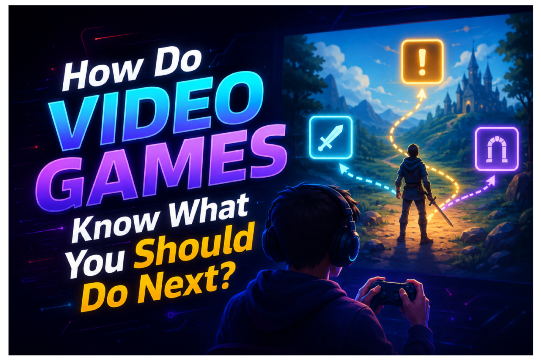
Games rarely explain everything at once. Instead, they use clues, characters, sounds, maps and rewards to help players figure out what to try next.
Good games usually don't need to tell you everything. They give you clues.
A glowing object might show where to go. A character might point toward a mission. A sound might warn you that something is nearby. A map can reveal a new area. Even the way a level is designed can guide your attention.
Game designers call these kinds of signals feedback or guidance. They help players understand what the game expects without stopping the action to explain every detail.
Imagine a game where you enter a dark room and see a bright doorway. Your eyes go there first. If the doorway is also the only path forward, the designer has guided you without saying, 'Walk through the door.'
Try designing your own game level on paper. Draw a starting point, a goal and three clues. Don't write instructions. Can a friend figure out where to go?
Then ask them what helped.
This is a useful design lesson: people don't always need more information. Sometimes they need the right information at the right moment.
Game design combines art, storytelling, technology and psychology. Designers are constantly asking: What does the player know? What might confuse them? What clue would help?
So the next time a game seems to 'know what you should do,' look closely.
A clever designer may be guiding you with details you barely noticed.