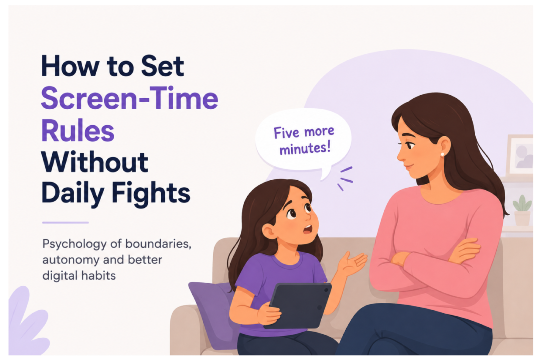
“Five more minutes!”
If screen time ends with an argument almost every day, the problem may not be that your child needs stricter limits.
It may be that the system around the limit isn't working.
Screens are unusually powerful attention-holders. Games, videos and social platforms provide rapid feedback, novelty and rewards. At the same time, children and adolescents are still developing the executive functions needed to shift attention, delay gratification and regulate impulses.
So when a parent suddenly says, “Turn it off,” a predictable conflict can emerge:
High engagement + abrupt transition + perceived loss of control = resistance.
The solution isn't simply more rules.
It is better-designed rules.
First: Stop Asking, “How Much Screen Time Is Too Much?”
There is no single number that defines healthy screen use for every child.
What matters is what the child is doing, when they are doing it, what it is replacing, and how it fits into the child's overall life.
The American Academy of Pediatrics has increasingly emphasized individualized family media plans rather than treating one universal daily limit as appropriate for every child.
Consider two children.
One spends an hour creating a school project, video-calling a grandparent and playing an educational game.
Another spends an hour scrolling highly stimulating short-form videos immediately before bed.
The clock says 60 minutes in both cases.
The developmental context does not.
A better question is:
Is technology supporting my child's life—or crowding it out?
If screen use consistently displaces sleep, physical activity, school responsibilities, face-to-face relationships or family interaction, the issue becomes much more significant.
Recent longitudinal research also suggests the relationship between screen use and socioemotional difficulties is bidirectional, rather than a simple story in which screens alone cause emotional problems.
That distinction matters.
We should manage screens without turning them into the villain.
The Real Goal: Build Self-Regulation
A parent can enforce a screen limit.
A child eventually needs to learn how to manage technology without a parent standing beside them.
That makes the long-term objective different.
Short-term goal
“My child stops when I tell them to.”
Better long-term goal
“My child gradually learns when, why and how to stop.”
This is where psychology becomes useful.
Children develop autonomy through appropriately structured choices. A useful parenting approach combines clear boundaries with appropriate involvement and agency, rather than relying entirely on control.
Research examining family factors and adolescent screen use similarly points toward positive family processes and democratic, media-specific parenting as potentially protective.
In other words:
Firm boundary ≠ authoritarian parenting.
You can be clear without being controlling.
1. Make the Rule Predictable
One of the biggest mistakes parents make is negotiating screen time in the moment.
“Can I play?”
“Not now.”
“How about after dinner?”
“We'll see.”
“Just ten minutes?”
Now the child has learned that screen access is a negotiation.
Instead, establish a predictable structure.
For example:
Homework → Outdoor/play time → Screen → Dinner → Family time → Bed
The exact schedule will vary by age and family.
The principle doesn't.
Predictability reduces negotiation.
Your child shouldn't need to repeatedly ask:
“Can I use my phone?”
They should know:
“When X happens, screen time becomes available.”
That changes the psychological experience from permission seeking to following a known routine.
Evidence from a 2025 systematic review found that implementation of screen-use rules was associated with lower screen use in young children, while parental modelling and using screens as a mood-regulation or reinforcement tool were associated with higher screen use.
2. Give Choices Inside the Boundary
This is one of the simplest ways to reduce power struggles.
Don't ask:
“Do you want to stop?”
If the answer can genuinely be no, you've accidentally turned a boundary into a negotiation.
Instead:
“Screen time ends at 7:30. Would you like to finish this level or stop after this episode?”
The boundary is fixed.
The child still has some agency.
Think of it as:
Parent controls the boundary.
Child gets appropriate choices within it.
This is fundamentally different from:
Parent controls everything.
The first teaches structure.
The second can create resistance.
3. Design the Transition
For an absorbed child, “turn it off now” can feel like being pulled abruptly out of an experience.
So don't make the ending a surprise.
Try:
20 minutes left
10 minutes left
5 minutes left
1 minute left
Done
The purpose isn't to endlessly warn your child.
It is to make the transition predictable.
And whenever possible, let the child reach a natural stopping point:
“You have five minutes. Finish this round, then we're done.”
This is particularly useful with games and activities that have clear completion points.
4. Don't Debate the Rule Once the Rule Has Ended
This is where consistency becomes more important than volume.
Imagine:
Parent: “Time's up.”
Child: “Five more minutes!”
Parent: “Okay, five.”
The child has just learned a behavioural lesson:
Persistence can change the outcome.
Next time, the negotiation may become louder.
Instead, try:
“I know you'd like more time. Screen time is finished.”
Then stop talking.
Not cold.
Not angry.
Just consistent.
The boundary should be boring.
You don't need a five-minute lecture explaining why the rule exists every evening.
Explain the rule when everyone is calm.
Enforce it calmly when the time comes.
5. Don't Use Screens as Your Primary Emotional Regulator
This one deserves special attention.
A child is upset.
You hand over the phone.
They calm down.
Problem solved.
Except that the child may gradually learn:
“When I feel uncomfortable, screens make the feeling go away.”
Research has associated using screens for mood regulation or as a behavioural reinforcement tool with greater child screen use.
That doesn't mean parents should never use a screen to help a child settle.
Life is messy.
But if the pattern becomes:
Bored → screen
Angry → screen
Waiting → screen
Sad → screen
Can't sleep → screen
then the device is doing more than entertaining the child.
It is becoming an emotional regulation strategy.
Children also need opportunities to practice:
waiting
boredom tolerance
frustration tolerance
calming themselves
finding alternatives
solving small problems independently
These are developmental skills.
They are not automatically installed.
6. Change the Environment, Not Just the Child
Good parenting often means designing environments so that the desired behaviour becomes easier.
Instead of constantly saying:
“Put your phone away.”
Create physical rules.
Try:
Dining table → screen-free
Bedrooms at night → screen-free
Homework space → entertainment-free
Family conversation → phones away
This reduces the number of decisions everyone has to make.
And remember:
Children learn media habits partly by watching adults.
A systematic review found that parental screen use and modelling are important factors in children's screen behaviour.
So if the family rule is:
“No phones during dinner.”
it should ideally apply to parents too.
Otherwise the child receives two messages:
The spoken message: “Phones aren't important right now.”
The observed message: “Except when adults want theirs.”
Children notice the difference.
7. Protect Sleep More Than the Clock
If you have to prioritize one screen boundary, make sleep one of them.
The question isn't simply:
“How many minutes did my child use a screen today?”
Ask:
“Did screen use interfere with sleep?”
Sleep supports learning, emotional regulation, attention and overall wellbeing.
A practical family rule can be:
Devices charge outside bedrooms overnight.
For younger children, parents can simply establish the routine.
For teenagers, involve them in creating it.
The goal isn't to create a nightly battle over the phone.
The goal is to make healthy sleep the default environment.
8. Talk About Content, Not Just Time
A screen isn't a single experience.
A child learning to code is having a different experience from a child watching endless algorithmically recommended videos.
A teenager talking to a close friend is having a different experience from compulsively checking social media.
So ask:
What are you doing?
not only:
How long have you been doing it?
Good questions include:
What do you enjoy about this?
What did you learn?
How does it make you feel?
Would you recommend it to a friend?
What would you do if someone online made you uncomfortable?
Is this helping you—or just keeping you scrolling?
This moves parenting from screen policing toward digital literacy.
9. Give Children Something to Move Toward
Removing a screen creates an empty space.
If the next activity is:
“Go do something.”
the child may reasonably respond:
“Like what?”
Instead, build a post-screen menu.
When screens end:
🏸 Play outside
📚 Read
🎨 Draw
🧩 Solve a puzzle
🎵 Play music
🍳 Help with cooking
🐾 Take care of a pet
🚲 Cycle
👨👩👧 Play a family game
✍️ Journal
The objective isn't to eliminate boredom.
Boredom is not an emergency.
Children need opportunities to discover what they can do when nobody is entertaining them.
10. Create Family Rules, Not Just Child Rules
Perhaps the most effective question isn't:
“What screen-time rules should my child follow?”
It's:
“What kind of digital culture do we want in our home?”
A family might decide:
Our 5 Digital Rules
1. Sleep comes first.
Devices stay outside bedrooms overnight.
2. People come before screens.
No phones during family meals or important conversations.
3. Responsibilities come before entertainment.
Homework, routines and agreed responsibilities happen first.
4. We choose content intentionally.
Not everything that captures attention deserves our attention.
5. Parents follow the spirit of the rules too.
We model the behaviour we expect.
Now screen management becomes a family culture, not a daily punishment.
The 5-Part Framework
If you remember nothing else, remember this:
P.A.C.E.
P — Predictability
Make screen access and stopping points predictable.
A — Autonomy
Give children meaningful choices within clear boundaries.
C — Context
Look at content, timing and what screen use is replacing.
E — Example
Model the digital behaviour you want your child to develop.
And add one final principle:
Consistency
A calm rule applied consistently is usually more sustainable than a strict rule applied unpredictably.
What to Say Tonight
Instead of:
“You've been on that phone all day. Give it to me.”
Try:
“From tomorrow, let's change how we use screens at home. We'll decide together when entertainment screens are available, when they're off, and where devices stay at night. You can help me design the routine.”
Then ask:
“What do you think would make this easier to follow?”
You might be surprised by the answer.
Children often resist rules less when they understand the reason behind them and have some legitimate voice in how the routine works.
The Bigger Picture
The objective of parenting in a digital world isn't to raise a child who can live without technology.
That's unrealistic.
The objective is to raise a child who can use technology without being controlled by it.
That means learning to:
pause → choose → use → stop → switch → reconnect
Those are self-regulation skills.
And self-regulation develops through practice.
So don't measure success by whether your child never argues about screen time.
Measure it by whether, over time, they need you less to manage it.
The ultimate screen-time rule
Don't just teach children when to put the screen down.
Teach them how to decide when to put it down.
Evidence Note:
This article draws on systematic reviews and longitudinal evidence examining parental modelling, family processes, parenting style, screen-use rules and children's screen behaviour. The evidence does not support a simplistic claim that screen time alone causes poor mental health; relationships are complex and can operate in both directions.
For individual children—particularly where screen use is significantly affecting sleep, school, relationships or emotional wellbeing—parents should seek advice from an appropriately qualified paediatric or mental-health professional.