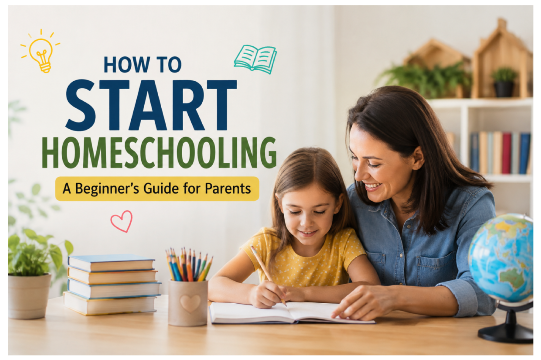
Start Small. Learn as You Go.
The first mistake many new homeschool parents make is trying to build an entire school before they've taught their first lesson.
You don't need a classroom, twenty workbooks, or a perfect timetable. You need a clear reason for homeschooling, an understanding of your child's current learning needs, and a simple plan for the next few weeks.
Start by asking three questions:
What does my child already know?
What does my child need to learn next?
How does my child learn best?
Then check your local legal and educational requirements. Homeschooling rules differ considerably by country and, in some places, by state or region, so don't rely on a generic internet checklist.
Next, choose your core subjects. For younger children, that might mean reading, writing, mathematics, science, and plenty of play, conversation, movement, and exploration. You don't have to teach every subject every day.
Then create a rhythm rather than a rigid timetable. Perhaps mornings begin with reading, followed by mathematics, outdoor time, and a project or science activity. A predictable sequence can be more useful than scheduling every minute.
Most importantly, observe before you optimize.
Your first month is not a test of whether you are a good homeschool parent. It is a period of discovery. Notice when your child concentrates, what sparks questions, what causes frustration, and what makes learning enjoyable.
Research on parental involvement suggests that parents' expectations, beliefs, and engagement matter, but more involvement is not automatically better. The quality and type of involvement matter.
Good homeschooling doesn't begin with having all the answers.
It begins with being willing to notice, adapt, and keep learning alongside your child.