
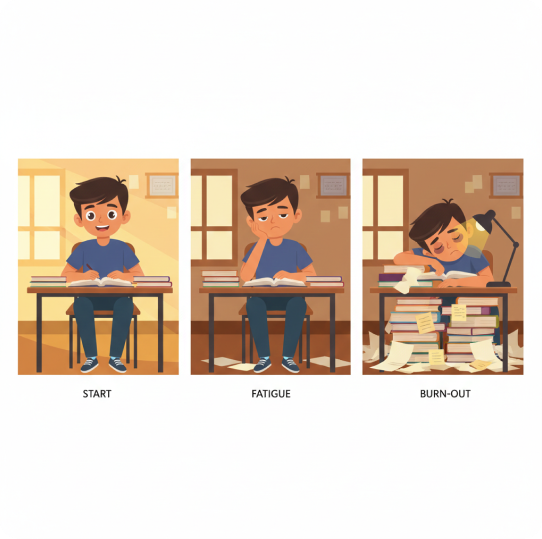
Most students who hit full burnout in Class 11 or 12 didn't arrive there in one bad week. It built over months — one skipped recovery here, one compressed sleep schedule there, one cancelled weekend there. And because school keeps moving regardless, there’s enormous pressure to push through every warning signal. The problem is that pushing through the early signs of burnout is precisely what converts a 2-week recovery into a 2-month one. The earlier you catch it, the faster you recover.
What Burnout Actually Is (And Isn’t)
Burnout is not laziness, low ambition, or mental weakness. It is a physiological and psychological state caused by sustained high-demand activity without adequate recovery. Research on adolescent academic burnout including studies from Indian educational contexts identifies three primary markers: emotional exhaustion (everything feels heavy, even things you used to enjoy), depersonalisation (you stop caring about outcomes you previously cared about), and reduced sense of personal accomplishment (effort stops feeling worth it). Identifying which of these three youre experiencing changes how you respond.
The Early Warning System
The Recovery Protocol
The research is clear: you cannot think your way out of burnout. You have to recover through it. This means building in genuine rest not scrolling, not binge-watching, but actual low-stimulation recovery like sleep, physical movement, time in nature, or an activity purely for enjoyment with zero performance component. Reduce your active workload by 30 40% for 10-14 days. Your output will drop short-term. Your capacity will restore fully. The counterintuitive truth: students who take a structured 10-day recovery mid-term consistently outperform students who push through burnout to the end without pausing.