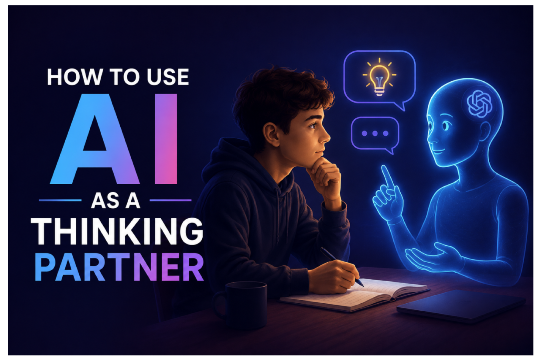
AI can explain a difficult idea in seconds, rewrite a paragraph or give you ten answers. That makes it useful—but it can also make learning disappear if you let it do the thinking for you.
AI can be incredibly useful for learning. You can ask it to explain a difficult concept, generate practice questions, quiz you, or show you another way to understand something.
The problem starts when you use AI to avoid the part that was supposed to make you better.
If your assignment asks you to explain photosynthesis and AI writes the explanation, you may have completed the task without building the skill. The finished answer can look excellent while your understanding remains shallow.
A better rule is simple: use AI to increase your thinking, not replace it.
Try this three-step approach:
1. Think first. Write what you already know before asking AI.
2. Ask for help, not a finished answer. Ask for an explanation, examples, questions or feedback.
3. Close the AI and retrieve. Explain the idea in your own words or solve a new problem without looking.
You can even ask AI to challenge your thinking: “What is wrong with my reasoning?” or “Give me a harder example.”
The goal is not to avoid AI. The goal is to make sure that after using it, you can do something you couldn't do before.
That is the difference between using a tool and outsourcing your brain.