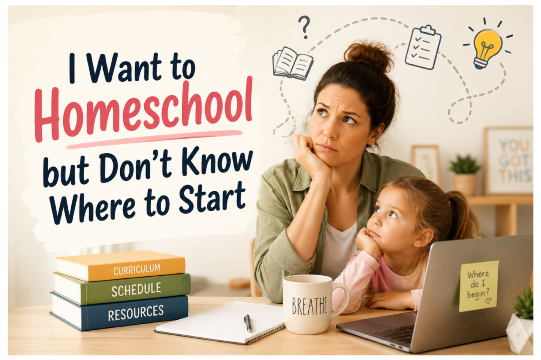
A calm, practical guide for parents taking the first step
If you're reading this, you've probably typed some version of that sentence into a search bar late at night. Maybe your child is struggling in school. Maybe your family's schedule doesn't fit a classroom calendar. Maybe you simply believe you can offer something different. Whatever brought you here, let me say the most important thing first: feeling overwhelmed at the start is normal, and it does not mean you're not cut out for this.
Homeschooling looks enormous from the outside because you're seeing the whole mountain at once. In practice, you only ever climb one step at a time. Here is how experienced homeschoolers actually begin.
Step 1: Get Clear on Your "Why"
Before curricula, schedules, or supplies, write down why you want to homeschool. Be honest and specific. "I want more flexibility" is a start. "I want my daughter to learn at her own pace in math while spending more time on her passion for drawing" is far more useful.
Your "why" matters for two reasons. First, it guides every decision that follows, from the method you choose to the resources you buy. Second, it will carry you through the hard days, and every homeschooling family has them. When you're tempted to quit or to turn your home into a miniature school out of anxiety, your "why" brings you back.
Step 2: Understand the Legal Requirements Where You Live
This is the one step you shouldn't skip or rush. Homeschooling laws vary enormously, not just from country to country but often from state to state or region to region. Some places require simple notification. Others require registration, record-keeping, assessments, or approved curricula. In some places, homeschooling is restricted or has unclear legal standing.
What to do:
- Search for your government's education department guidance on home education.
- Look for a local or national homeschool association. These groups usually explain the rules in plain language and often have legal experts.
- Find out whether you need to formally withdraw your child from their current school, and how.
- Ask what records you'll be expected to keep, such as attendance, work samples, or test results.
Do this before you withdraw your child from school. It prevents avoidable problems later.
Step 3: Learn the Main Approaches (Then Don't Over-Think It)
You don't need to pick a philosophy and commit for life, but knowing the landscape helps you recognize what resonates. The most common approaches:
- Traditional or "school at home": Uses textbooks and a structured schedule, similar to a classroom. Reassuring for new homeschoolers, though it can feel rigid.
- Charlotte Mason: Emphasizes short lessons, great books, nature study, art, and music. Rich in literature and observation.
- Classical: Follows a structured progression that builds from foundational facts to logic to rhetoric and argument.
- Montessori-inspired: Hands-on, child-led learning with carefully prepared materials, especially popular for younger children.
- Unschooling or interest-led: Learning follows the child's curiosity, with the parent as guide and resource provider.
- Eclectic: A blend of whatever works. This is, honestly, where most families land.
My advice: start with something simple and structured enough to give you confidence, then loosen up as you learn what your child actually needs. Almost no one gets the first curriculum choice perfectly right, and that's fine.
Step 4: Know Your Child, Not Just the Subjects
The greatest advantage of homeschooling is that you can teach the child in front of you. Spend your first weeks observing:
- How does your child learn best: by doing, listening, reading, or talking it through?
- When is their energy highest? Many children do their best thinking in the morning, but not all.
- What are they curious about? Dinosaurs, coding, baking, birds?
- Where are they genuinely behind, and where are they ahead?
These observations will shape your plan better than any curriculum catalog.
Step 5: Start With the Core, Keep It Small
New homeschoolers often try to replicate an entire school day with seven subjects, a rigid timetable, and a color-coded planner. This is the fastest route to burnout.
Instead, begin with the essentials:
- Reading and writing
- Math
- One "everything else" thread, such as science, history, or a project of your child's choosing
At home, one-on-one instruction is remarkably efficient. Younger children often need only one to two hours of focused work a day; older children, more. The rest of the day is for play, reading, chores, cooking, outdoor time, and following interests, all of which are real learning.
Step 6: Consider a "Deschooling" Period
If your child is coming out of a school environment, especially after a stressful experience, give them time to decompress. A common rule of thumb is about one month of recovery for every year spent in school, though this is a rough guide rather than a law. During this time, focus on rest, reading together, outings, and rebuilding curiosity and trust. You'll be surprised how much they learn while you're "doing nothing."
This period is also for you. Many parents need to unlearn the idea that learning only counts if it looks like school.
Step 7: Choose Resources Wisely and Cheaply
The homeschool market is vast and seductive. Resist the urge to buy everything. A sensible starting kit includes:
- One core math program
- A reading list of good books (your library is your best friend)
- A simple writing routine, such as a daily journal entry or narration
- Free or low-cost resources for science and history, including documentaries, museums, nature walks, and online courses
Try before you buy where possible, use sample lessons, and borrow from other families. If something isn't working after a fair trial, change it without guilt. The curriculum serves your child, not the other way around.
Step 8: Build a Rhythm, Not a Rigid Schedule
You don't need to start at 8:00 sharp. What helps is a predictable rhythm: a consistent start, core subjects early, breaks built in, and a clear finish. A simple daily flow might look like this:
- Morning routine and a read-aloud
- Math and language work
- Break and outdoor time
- Project, science, or history
- Afternoon free time, with independent reading or hobbies
Expect your first schedule to fail. That's not a flaw; it's data. Adjust and try again.
Step 9: Find Your Community
Homeschooling is not isolating unless you let it be. Look for:
- Local homeschool groups and co-ops
- Library programs, sports teams, music or art classes, and scouting groups
- Online communities for parents, which are helpful for advice, but be careful of comparison
- Regular playdates and family outings
Community serves two purposes. Your children get friendships and group experiences, and you get encouragement from people who've been where you are.
Step 10: Track Progress Simply
You don't need elaborate assessments to know whether your child is learning. Keep a light record: a folder of work samples, a reading log, notes on projects and field trips. Check in on skills regularly. Can they read more fluently than three months ago? Can they explain what they've learned? Do they handle the math concepts you've taught?
If your region requires formal assessments or reporting, build those into your plan from the start so they never surprise you.
Common Fears, Answered Honestly
"I'm not qualified." You don't need to be a trained teacher to guide a child's learning, especially in the early years. You need to be willing to learn alongside them, find good resources, and stay consistent. If you can read, you can teach a child to love reading.
"What about socialization?" Homeschooled children can have rich social lives, but it takes intention. Build it into your week, and notice that mixed-age interaction, with neighbors, relatives, and community members, is often more like the real world than a same-age classroom.
"What if I ruin their education?" Every parent worries about this, and the worry itself shows how much you care. Children are resilient. You can always adjust, hire a tutor for a hard subject, or re-enroll in school if it isn't working. Homeschooling is not a one-way door.
"Can I afford it?" It can be done on almost any budget. Libraries, free online resources, and used materials go a long way. The larger cost for many families is time and income flexibility, which is worth planning for honestly.
Your First 30 Days: A Simple Plan
- Week 1: Write your "why." Research your local legal requirements. Join one local or online homeschool group.
- Week 2: Observe your child's learning style and interests. Visit the library. Sample one or two curricula.
- Week 3: Choose your core resources for reading, writing, and math. Draft a flexible daily rhythm.
- Week 4: Begin gently with short sessions, then build up. Reflect on what's working and adjust.
A Final Word
The families who thrive at homeschooling are rarely the ones with the perfect plan. They're the ones who start small, stay curious, adapt often, and keep their relationship with their child at the center. Academic progress follows connection far more often than the reverse.
You don't need to know everything today. You only need to take the next step. And now you know what it is.
Note: Always verify current homeschooling regulations with your local education authority or a reputable homeschool association, as laws change and vary by location.