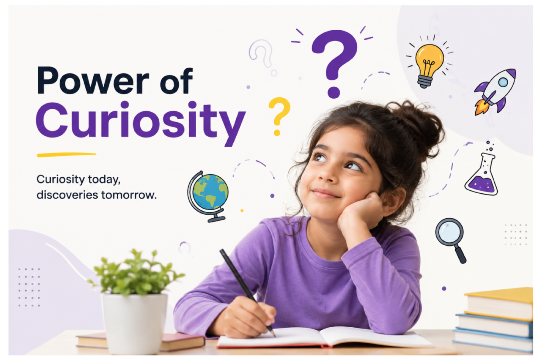
Curiosity is often treated as a personality trait—something a child either “has” or doesn’t. Developmental research suggests a more useful view: curiosity is a learning behaviour that adults can either strengthen or accidentally shut down.
When children ask “Why?”, “What if?” or “How does this work?”, they are doing more than seeking information. They are identifying a gap between what they know and what they want to understand. That gap creates a powerful motivation to explore, predict, test and learn.
The problem is that adults can unintentionally train children to stop asking questions. “Because I said so,” rushed answers, correcting every mistake, or dismissing unusual questions may communicate that questioning is inconvenient—or that there is one “right” way to think.
A simple framework: Pause → Probe → Explore
1. Pause.
Instead of immediately answering, give the child a moment to think. “Hmm, what do you think?”
2. Probe.
Ask questions that extend their reasoning: “What makes you think that?” or “What could we test?”
3. Explore.
Turn curiosity into action. Look something up together, experiment, draw a solution, observe what happens, or try again.
Importantly, curiosity does not mean giving children unlimited freedom or answering every question perfectly. It means treating questions as invitations to think rather than interruptions to manage.
A child who learns that questions are welcome develops more than knowledge. They practise forming hypotheses, tolerating uncertainty, seeking evidence and changing their minds.
The goal of parenting, therefore, isn't to raise children who always know the answer.
It is to raise children who aren't afraid to ask better questions.