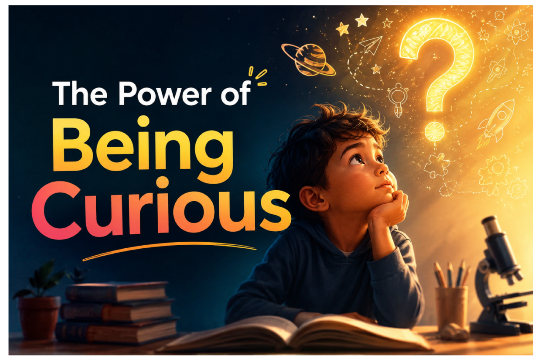
Curiosity begins with a simple feeling: 'I wonder why?' That question can be more powerful than already knowing the answer.
Curiosity starts with a tiny question: Why?
Why is the sky blue? Why do cats purr? Why does popcorn pop? Why does a ball bounce?
Questions are powerful because they turn your brain from a spectator into an explorer. Instead of simply receiving an answer, you start looking for evidence, making guesses and testing ideas.
You don't have to know a lot before you can be curious. In fact, curiosity often begins when you realise you don't know something.
Try a 'five questions' challenge. Pick an ordinary object, such as a spoon. Ask five questions about it. Why is it curved? Why is it shiny? Why is it usually made from metal? Could it be made from wood? Why does it feel cold sometimes?
Then choose one question and investigate it.
Notice what happens: one answer often creates another question. That's how curiosity can turn a tiny mystery into a whole learning adventure.
Curiosity also means being willing to change your mind. You might make a guess and discover that the evidence points somewhere else. That isn't failure. It is how learning gets better.
So the next time an adult says, 'That's just how it is,' you can politely ask, 'But why?'
You don't need to have all the answers.
Sometimes the best superpower is knowing which question to ask next.