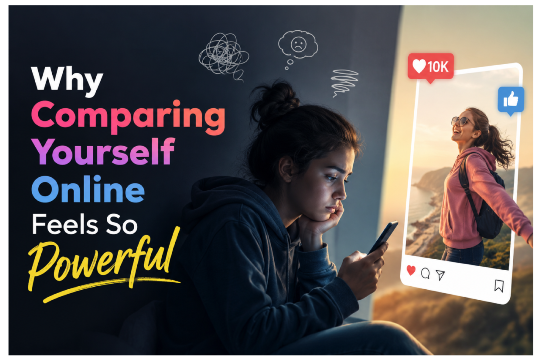
Scrolling can turn someone else's best moment into a measuring stick for your own life. The problem is that you usually see a selected version of another person's reality while experiencing your own in full.
Imagine seeing ten people who seem more successful, more attractive, more talented or happier than you before breakfast.
Your brain may start making comparisons automatically.
Social comparison is a normal human behaviour. We use other people as information about ourselves and the world. But social media changes the ingredients: you can see hundreds of carefully selected moments from other people's lives in a few minutes.
Meanwhile, you experience your own life from the inside—including boring days, mistakes, worries and unfinished work.
That creates an unfair comparison.
The problem isn't that every post is fake. It's that a post is usually a selection. You are comparing your full reality with someone else's edited sample.
Try changing the question. Instead of “Why am I not like them?” ask, “What exactly am I comparing?”
Is it a skill? A number of followers? Appearance? Money? A single achievement?
Then ask whether that comparison actually matters to a goal you chose for yourself.
You can also notice what happens immediately after scrolling. Do you feel inspired, neutral, pressured or inadequate?
The goal isn't to stop noticing other people. It's to become more aware of what your brain is doing with what it sees.
You don't need to win a competition you never agreed to enter.