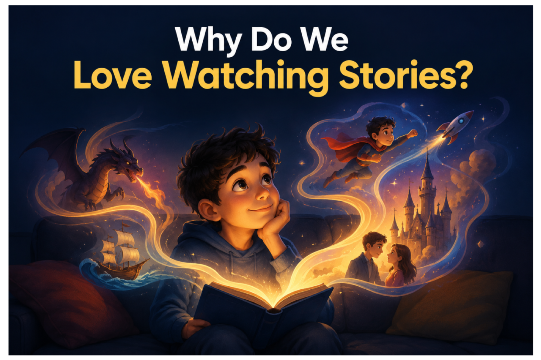
A good story can make us laugh, feel nervous, cheer for someone or imagine living somewhere completely different. Why does our brain enjoy that?
A good story can make you laugh, worry, feel surprised or cheer for someone you've never met.
Stories give our brains a chance to imagine events from another person's point of view. When we follow a character who has a problem, we start wondering what they will do next. We may even imagine how we would feel in the same situation.
That's one reason stories can help us think about people who are different from us. A story doesn't magically make us understand everything about another person, but it can give us a safe space to explore different experiences and emotions.
Vlogs and everyday videos can work differently. Instead of a made-up character, you might watch a real person cooking, travelling, playing a sport or sharing part of their day. Your curiosity is often driven by the question: 'What happens next?'
Try a storytelling challenge. Take an ordinary event—such as losing your favourite pencil—and turn it into a tiny story. Give it a beginning, a problem and an ending.
Then change the main character. How would the story feel if it were told by your friend? Your teacher? The pencil?
Changing the point of view changes the story.
That's the magic of storytelling: the same event can look completely different depending on who is telling it.
And maybe that's why we keep watching. We aren't only asking, 'What happens next?' We're also asking, 'What would it be like to be there?'