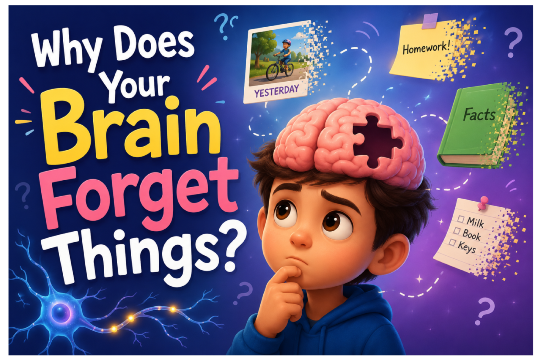
Forgetting is not a sign that your brain is bad at learning. In fact, forgetting is part of how learning works.
Have you ever walked into a room and forgotten why you went there? Or learned a new word and then forgotten it the next day? Don't worry—your brain is not broken.
Your brain receives an enormous amount of information every day. It cannot keep every detail forever, so it constantly decides what seems useful and what can fade into the background.
Things you pay attention to, connect to something you already know, practise, or use again are more likely to stick.
There is a useful trick hiding here: don't just read something once. Try to remember it without looking. This is called retrieval practice. For example, after reading three facts about planets, close the page and tell someone the facts from memory. The small effort of pulling information back can strengthen learning.
You can also make a 'memory connection'. If you learn that bees communicate using movement, imagine a tiny bee doing a dance to deliver a message. Strange or funny pictures can make information easier to remember.
Try this today: learn three new facts. Wait ten minutes. Then see how many you can recall without checking. Tomorrow, try again.
Forgetting isn't the opposite of learning. Sometimes, it is the reason your brain gets a chance to practise remembering.