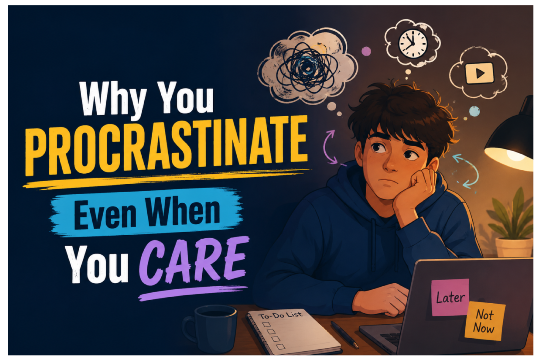
Procrastination is often described as laziness. That explanation misses something important: people frequently delay tasks they genuinely want to complete. The obstacle can be emotion, uncertainty, perfectionism or simply a task that feels too large.
If you have ever delayed an important task and then felt guilty about it, you may have wondered: “Why am I doing this when I actually care?”
Because procrastination isn't always about not caring.
A task can trigger discomfort: uncertainty, boredom, fear of doing badly, perfectionism or the feeling that there is too much to do. Avoiding it provides a tiny burst of relief. Unfortunately, the task is still waiting later.
That creates a loop:
Task → uncomfortable feeling → avoidance → temporary relief → task becomes more stressful.
One way to interrupt the loop is to make the starting action extremely specific.
Don't write “study biology.” Write “open the chapter and answer question one.”
Don't write “finish project.” Write “create the title slide.”
You can also use a short starting window. Tell yourself you only have to work for ten minutes. The goal is not to trick yourself into finishing everything. It is to make beginning less emotionally expensive.
Then notice what happens.
Often, once you start, uncertainty falls because you can finally see the actual problem instead of imagining it.
Procrastination is not proof that you're lazy or incapable.
It is a behaviour pattern.
And behaviour patterns can be redesigned—one small start at a time.